How modular buildings strike a balance between standardization and customization
Compared to traditional construction methods, modular design offers unparalleled flexibility, efficiency, and scalability. The true value of modular homes lies in their replicability. Homes are constructed in a controlled factory environment using prefabricated modules. These modules are then transported to the construction site for assembly. Because of factory production, modular homes offer advantages in efficiency and quality. This means faster construction times, stricter quality control, and potentially lower costs and environmental impacts.
But in a world where customization is paramount, how can modular homes meet the diverse needs of different individuals?
While modular construction relies on standardized components, its appeal lies in its flexibility. Innovative designs can leverage these building blocks to offer a variety of options for floor plans, finishes, and exterior designs, allowing homeowners to customize their dream home without sacrificing the speed and cost-effectiveness of modular construction. Modular construction offers a compelling combination of affordability and adaptability. Manufacturers can leverage economies of scale by deploying standardized components, thereby reducing costs for potential homebuyers.
The opportunity lies in finding a balance between maintaining uniqueness and employing flexible modules that can seamlessly integrate into different environments. Many manufacturers are working to offer a range of pre-designed modules with varying layouts, sizes, and features. This allows buyers to select a module tailored to their specific needs, such as bedrooms, bathrooms, living areas, or even balconies or home offices. While the core structure of the modules remains standardized, buyers typically have some choice in finishes, fixtures, and appliances. This allows them to customize the interior aesthetic and functionality to their preferences.
Modular homes should not be a "one-size-fits-all" solution. Instead, in-depth research is essential to understanding the needs, desires, and challenges of future residents. This allows architects to identify key design drivers and create flexible modular components. This allows for a range of modular sizes to accommodate varying family sizes or create flexible layouts. By prioritizing discussion and research with clients, modular homes can be designed to be responsive, creating a sense of customization even with standardized components.
Today's modular architects are pushing the boundaries of form, creating architectural expressions that seamlessly combine creative design with the inherent practical advantages of modular construction. These adaptable building modules can be assembled into vibrant communities that resonate organically with their surroundings.
The appeal of modular homes lies not only in their affordability and speed of construction, but also in their ability to inspire creativity and a sense of community. As modular construction continues to evolve, the key will be to preserve the inherent benefits of standardization while giving buyers the freedom to create a living space that truly reflects their individual needs and tastes.
Modular Construction vs. Traditional Prefabricated Construction
People often confuse modular construction with traditional prefabricated construction, even mistakenly believing they are the same thing, but this is not the case.
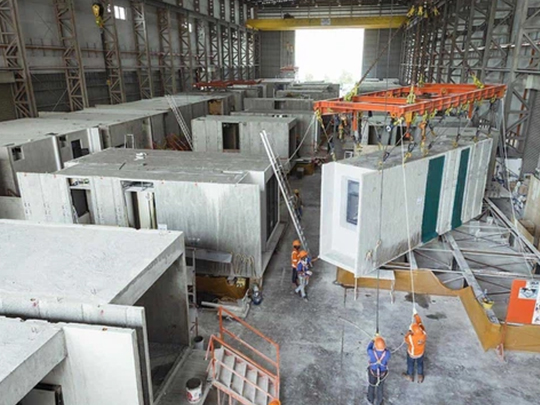
Modular construction, also known as "box construction," consists of prefabricated units that can include a kitchen, a bathroom, or even a single room. They are prefabricated in a factory using the same materials and designed to the same specifications and standards as traditional construction facilities—but in about half the time.
Ultimately, these units are transported to the site and assembled like building blocks, further reducing on-site work time.
Comparison between Modular and Traditional Prefabricated Buildings
Both modular and traditional prefabricated buildings utilize environmentally friendly construction methods. They are prefabricated in factories and then assembled on-site. The main differences between the two construction methods are:
01 Prefabricated Components
① Traditional Prefabricated Structural System:
Each component must be prefabricated in the factory according to the designed dimensions. Because some components are numerous and dispersed, the production process requires accurate numbering and supervision to ensure orderly arrangement and avoid errors. During assembly, finding the right component from the vast number of components increases the workload.
② Modular Structural System:
The entire room is prefabricated in the factory as a single spatial module. Equipment, piping, finishes, and fixed furniture are installed during module fabrication, and facade decoration can also be completed simultaneously.
The prefabricated components of the modular structural system, including beams, columns, and steel joints, are assembled into individual modules after factory prefabrication. Standardized component dimensions and process flow allow for streamlined production, reducing labor input and improving speed and efficiency.
02 Transportation Process
① Traditional Prefabricated Structural System:
Prefabricated components in traditional prefabricated and modular structural systems can be transported to the construction site via trailers.
However, some components in traditional prefabricated structural systems are often small, numerous, and scattered, making loading and unloading time-consuming and prone to damage, making them unsuitable for long-distance transportation.
② Modular Structural System:
In contrast, modular structural systems address this issue.
Modules are factory-assembled according to design specifications and securely connected with high-strength bolts or welding, ensuring optimal integrity and resistance to damage.
During transportation, modules can be stacked, improving space utilization, saving loading and unloading time, and facilitating transportation. Modules can be transported by trailer for short distances and by containerized finished goods for longer distances.
03 Assembly Method
① Traditional prefabricated structural systems:
Traditional prefabricated structural systems have a wide variety of components, a large number of components, and a dispersed distribution. This makes assembly difficult, requires the cooperation of specialized technicians, and requires significant human and material resources.
② Modular Structural Systems:
Modular building structural systems are assembled on-site using a "building blocks" approach. High-strength bolts are used to connect modular unit nodes, ensuring reliable connections between modules to form a complete building. This connection method is simple, time-saving, fast, high-quality, labor-saving, and economical. Modular construction is an optimized and upgraded version of traditional prefabricated building systems and represents the future trend in prefabricated building development. Its modularization rate can reach over 90%, and building components are prefabricated in factories, shortening on-site construction time and eliminating wet work, thereby reducing environmental pollution and better meeting green building requirements. At the same time, it can save materials and avoid waste. As people's demand for sustainable, affordable and adaptable living spaces continues to grow, modular construction will become more important.
*Reprinted from "Modular Architecture Network." If any infringement occurs, please contact us immediately for removal.
评论
发表评论